







Artist’s Statement: Immersion Project
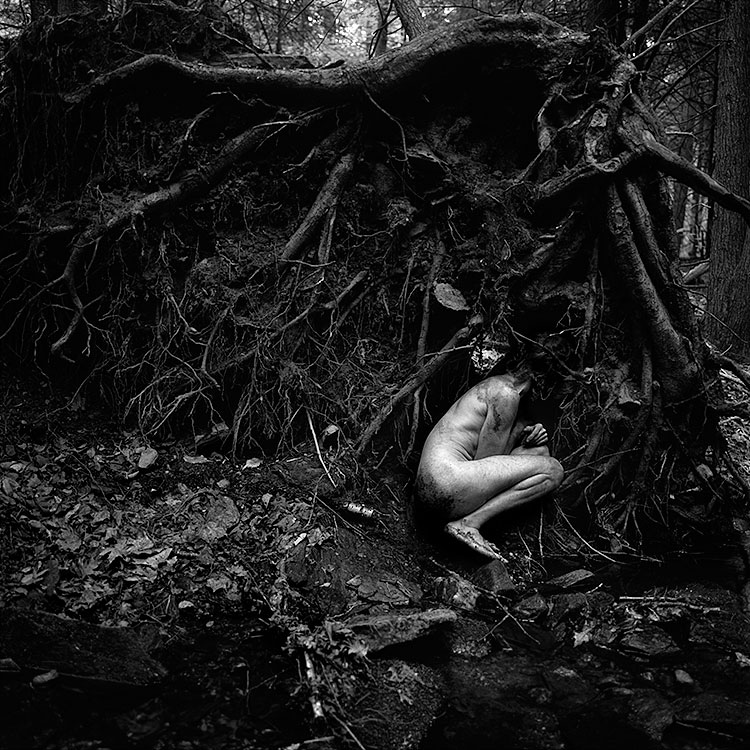
Roots 2014
Copyright © 2014 by Bruce G. Hooke. All Rights Reserved.
My body is as natural as a tree or a bear or the earth beneath our feet, and as fragile and fleeting as any other living thing. So is yours. All that we make, touch and use comes ultimately from nature. Death returns us to nature, our atoms endlessly recycled. Yet for millennia in Western cultures nature has been perceived as an “other,’ more and more distant from our daily lives.
This can be traced back at least to the Biblical story of God creating the earth for man to rule over, locating man under God but above the earth. It carries right through to the modern era when science has taught us so much about nature but from the perspective of a dispassionate observer looking “in’ from the “outside.’ Technology has allowed most of us to move further and further from the natural world. We go for a walk in the woods but then return to life indoors and in cities, where we feel insulated from nature‘s forces.
But we are at a turning point. In recent decades pollution in the water, air and soil; climate change–driven droughts and storms; and simply a growing awareness of nature‘s processes have all brought home the message that we are part of nature and nature is part of us.
A growing awareness of other cultures has opened up more ways for us to understand our relationship to nature. Are mountains sacred places to be circled, walked around, but not climbed up? Or does climbing mountains teach us humility and bring us closer to the transcendent? Or are mountains a source of minerals to make smart-phones and lumber to build houses? Did God lift up the mountains or are they the result of vast natural forces, or maybe both? To an unprecedented degree in human history it is up to each of us to decide how we understand our relationship to nature.
These questions kept churning in my mind but I realized that thinking about them would only provide part of the answer. The rest had to come from experience. So I set out to explore my own relationship to nature on very physical terms, and to tell the story of this journey. I asked the questions: “what does it feel like and what can I learn by physically immersing my body in nature?’ “How do I go beyond just walking in the woods but in ways that lead me deeper in?’ It‘s easy to use nature as a testing ground, a place to physically challenge ourselves, a place to get an adrenalin fix. I wanted something else. I wanted to slow down and feel nature more fully, more deeply, and more physically.
I found that sometimes nature holds my body gently: I fit as an infant fits into a womb. But often I feel nature pushing back and I emerge scratched, bruised, cold and muddy. Revealed to me in the process is the similarity between my skin and the bark of a tree, and between the muscles under my skin and the wood beneath the bark. I‘ve learned at a very physical level that nature is often ungentle but that my body is closely akin to the trees, rocks, and rivers. I‘ve also learned that I am really quite small and fragile amidst nature‘s vastness and power.
Since this is a very personal journey I‘m on, I photograph myself rather than introducing another person, a “model,’ into the story. I shed my clothing for this work so I can more fully feel the rocks, trees, water, earth, sun and rain touching my skin.
Indoors, away from nature, I often feel alone in this world. Alone in nature I am at home, feeling my kinship with the world.
I‘m interested, as well, in pushing back at the conventions around the portrayal of male and female human bodies, especially in relationship with nature. In both photography and painting it has long been the norm in Western art to focus on the female nude, especially in the context of nature. Male nudes, when they appear, are commonly portrayed in powerful, dynamic, athletic poses while women are more likely to be in passive poses. Women are also commonly portrayed as closer to nature, often with a subtext of both women and nature being passive relative to men. Through my photography I hope to show that men and the male body are as close to nature and as worthy of artistic attention as women and the female body. And I hope to show that nature is not passive, nor is our relationship to nature, no matter whether we are male or female.
We are all, men and women alike, part of nature, but we who are products of Western culture are also inescapably distanced from nature by a cultural history stretching back thousands of years. I hope to reduce this divide a little for myself, and for you who are seeing this work and maybe putting yourself, mentally, where I am in the picture. Or you might go outside try what it feels like yourself.
Artist’s Statement: Silhouette Series
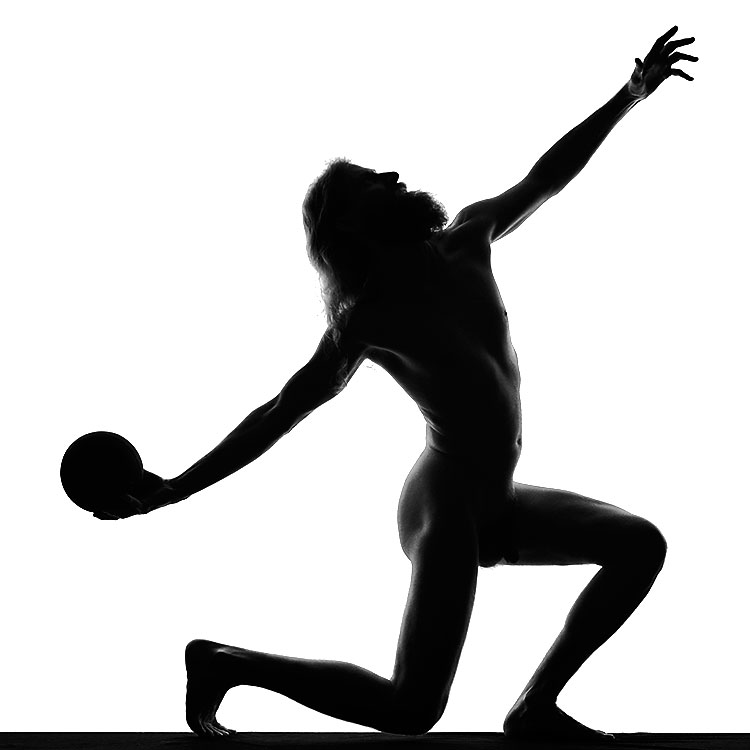
Silhouette With Ball 2005
Copyright © 2005 by Bruce G. Hooke. All Rights Reserved.
I think of this work as “static dance.” This is a bit of an oxymoron since movement is a central element of dance, but what photography can do that dance cannot is freeze a moment in time and allow us to contemplate it. I love the expressive potential of movement in dance, but I also love slowing things down and thinking about the expressive potential of a single position. Since I am most interested in the overall form created by the human body, I make silhouettes, with just a little detail inside the outline to provide a sense of depth and enhance the form.
Like the ancient Greeks, I see the male body as beautiful in its own right, but in my photographs I try to move beyond a simple celebration of the body and capture a sense of emotion in my images. Life, for me, is often rather mysterious and even puzzling at times. At one moment, struggle might mingle with hope and a touch of sadness to create a complex mix of feelings, and an hour later everything might have changed. This is what makes life rich, but also what makes it challenging. I hope my photographs capture at least a little of this richness and challenge.
I primarily use myself as the model because an important part of my process is exploring the positions I can take on with my own body. I am the dancer in an improvisational dance, rather than just an observer providing feedback to a model and occasionally snapping the shutter.
The camera I used for making these photographs is a Hasselblad 503CW medium format camera, loaded with traditional black and white print film. Since I cannot trigger the shutter directly when I am in the picture, I fabricated a mechanism that allows me to trigger a timer connected to the camera's shutter, once I am in position in front of the camera.
Artist’s Statement: Nature Photographs
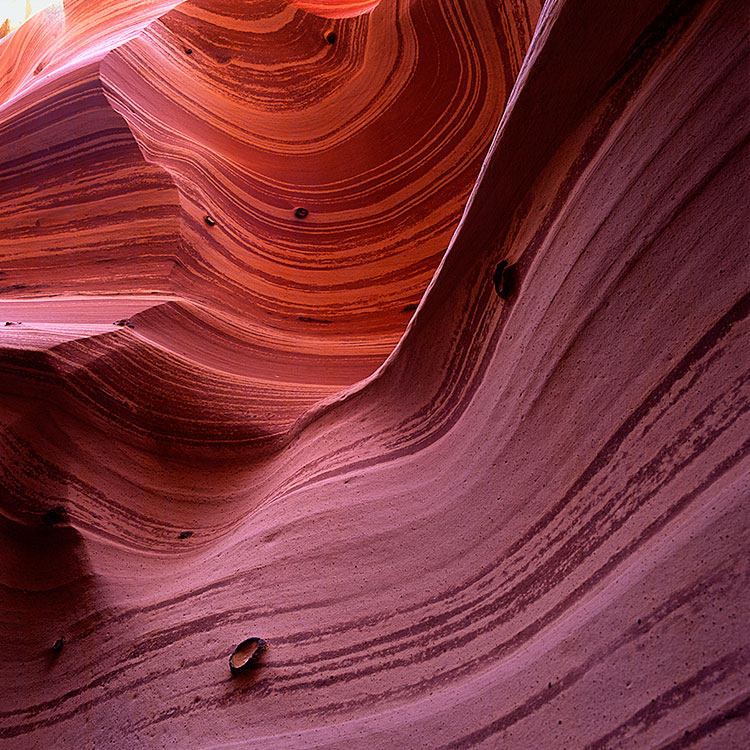
Slot Canyon, Utah 2010
Copyright © 2010 by Bruce G. Hooke. All Rights Reserved.
Vast canyons and towering mountains are glorious, but just as glorious to me are the patterns made by water dripping down the face of a rock, by lichen growing on a rock, and even the patterns within the very rock, put there by the amazing processes through which rock is created. When I am outdoors my eye is drawn to these subtle details of nature, and photography is my way of recording what I have seen so that I can share it with others.
I especially enjoy finding nearly abstract patterns in nature that, like an abstract painting, allow our eye to find order, flow and movement in apparent chaos. To me such patterns allow us to see and appreciate nature on a different level.
As an artist I have long been drawn to natural patterns and processes. In college and graduate school I studied ceramic sculpture, an art medium closely tied to the land since the materials come out of the earth. My thesis project for my masters at Cranbrook Academy of Art involved a sculpture in and over a small stream. The sculpture was designed to interact with and reveal the erosional processes of the flowing water. As an undergraduate at Wesleyan University I also took a variety of classes in geology. This experience led me to more consciously incorporate geological ideas into my artwork.
However, college was not my first exposure to geology and natural science. My father is a geologist and both of my parents love the outdoors, so I was introduced to the outdoors and to looking thoughtfully at the land around me at an early age. I have been fortunate to go to many wonderful places, from Alaska to Utah to southern Africa to western Greenland. In all of these places my camera has helped me see the land more clearly, and record for others what I have seen.
I use a variety of cameras to make my photographs, but my two favorite cameras are a Hasselblad 503CW medium format camera and a Nikon F3 35mm camera. I use traditional slide and black & white film to make all of my photographs because I like the image quality I get from film.